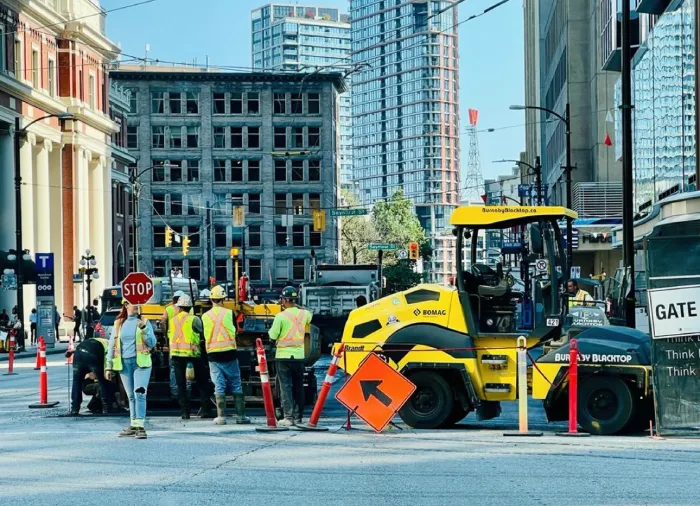
In the Lower Mainland, pavement failure is often blamed on traffic, age, or weather. While those factors all play a role, they are usually not the true root cause. More often than not, the real issue is water.
From Burnaby and Vancouver to Surrey, Richmond, and the Tri-Cities, the Lower Mainland’s wet climate puts constant pressure on asphalt and concrete surfaces. If drainage is poor, water seeps into the pavement structure, weakens the base below, and causes surfaces to fail much sooner than they should.
That is why drainage is not just an important part of paving. In this region, it is often the single biggest reason pavement breaks down.
Key Takeaway: If your asphalt or concrete keeps cracking, sinking, or developing potholes in the same areas, the problem may not be the surface itself. It may be a drainage failure underneath or around it. In the Lower Mainland, proper paving starts with proper water management.
Why Drainage Matters More in the Lower Mainland
This is not a generic paving issue. It is especially important in our part of British Columbia because of the way local conditions affect pavement performance.
The Lower Mainland deals with:
- long wet seasons,
- repeated heavy rainfall,
- freeze-thaw cycles in colder months,
- clay-heavy and moisture-sensitive soils in some areas,
- high water tables in municipalities like Richmond and Delta,
- and sloped properties in places like Coquitlam and Port Moody.
That combination creates an environment where even a well-finished asphalt surface can fail early if the drainage underneath or around it has not been designed correctly.
A paving project can look great when it is first completed. But if water has nowhere to go, that same project may begin cracking, settling, or heaving long before it should.
The Problem Most People Miss
Many talk about drainage as if it is just one item on a checklist. In reality, drainage is part of the pavement’s structural system.
Pavement does not fail only because the top layer wears out. It often fails because water gets below the surface and starts attacking the base from underneath.
This is what makes drainage such a critical issue. If water is allowed to:
- pool on top of the pavement,
- seep through cracks or joints,
- collect near the edges,
- saturate the sub-base,
- or flow toward structures,
the pavement begins to weaken from the bottom up.
That kind of failure is not always obvious on day one. In fact, some drainage-related damage takes time to show up. But once it starts, it tends to accelerate.
How Poor Drainage Causes Pavement Failure
The process is straightforward, but the consequences are serious.
1. Water Penetrates the Surface:
Even a pavement surface that looks solid can allow water through over time. Small cracks, joints, edges, and weak spots in compaction all give moisture a way in.
2. The Base Becomes Saturated:
Once water reaches the base layer, the supporting material loses strength. Instead of acting as a stable foundation, it begins to soften, shift, and compress.
3. The Surface Starts to Move:
As the base weakens, the asphalt or concrete above it starts to respond. That can show up as cracking, rutting, depressions, or uneven settlement.
4. The Damage Gets Worse:
Now that the pavement surface is compromised, even more water enters. The cycle repeats and the failure spreads.
5. Freeze-Thaw Makes It More Severe
When temperatures drop, trapped moisture expands as it freezes. That extra pressure pushes up from below and can turn a minor problem into a major one very quickly.
This is why drainage-related paving failure is so frustrating. It compounds. What begins as a small issue often becomes a much larger repair if the root cause is ignored.
Common Signs Drainage Is the Real Problem
Property managers, engineers, strata councils or even home owners often assume they need patching or resurfacing when the real problem is water movement.
Here are some signs that drainage may be the issue:
- standing water after rain,
- potholes that keep returning in the same place,
- cracks that reopen shortly after repair,
- low spots in parking lots,
- pavement edges breaking apart,
- settlement near drains or catch basins,
- icy patches forming repeatedly in winter,
- water flowing toward buildings or parkade entrances,
- and soft spots under vehicle traffic.
If the same areas keep failing, that is usually a warning sign that the problem goes deeper than the surface layer.