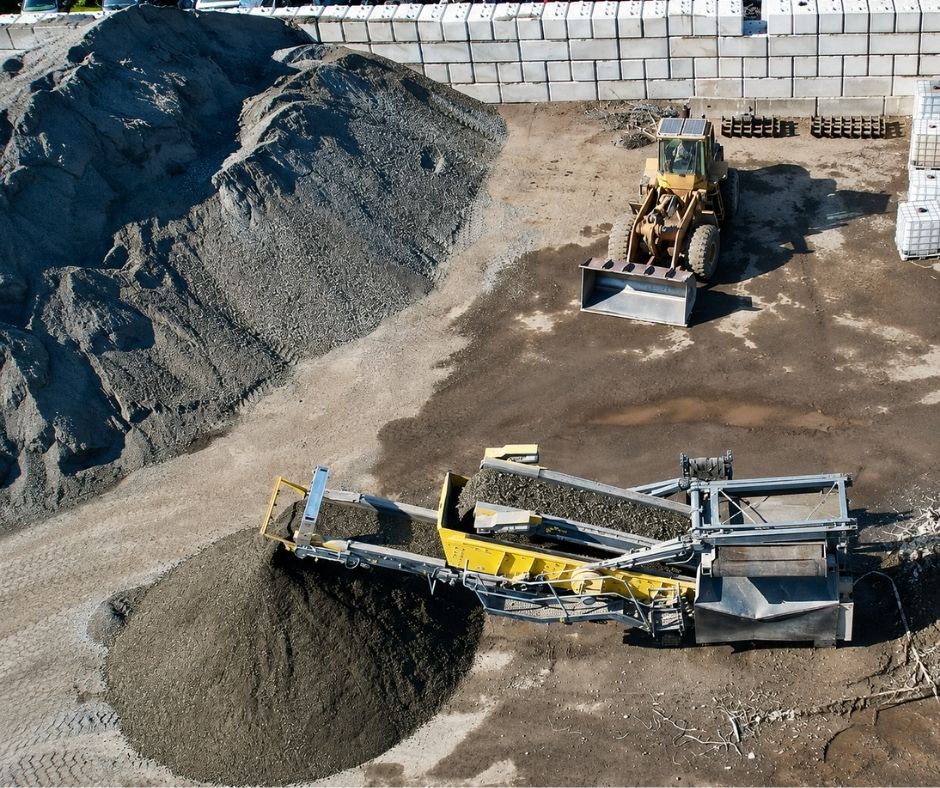
If you’ve ever watched us remove an old parking lot or mill an asphalt roadway, you might have wondered: What happens to all that old asphalt?
It doesn’t necessarily become waste.
Asphalt pavement can be recovered and processed into Reclaimed Asphalt Pavement, or RAP.
That means material from yesterday’s parking lot or roadway can potentially become a useful resource for future construction instead of simply taking up landfill space.
Here’s how it works.
What Is Reclaimed Asphalt Pavement?
Reclaimed Asphalt Pavement (RAP) is asphalt pavement material that has been removed from an existing paved surface for processing and reuse.
The material still contains the aggregate and aged asphalt binder that were part of the original pavement.
RAP can come from several types of projects.
You might generate it when you’re reconstructing an old parking lot, rehabilitating a road, excavating through an existing paved area or milling an asphalt surface.
The key idea is recovery. The pavement has reached the end of its useful life in one location, but the material itself may still have value.
How Do You Remove Old Asphalt?
There are two very different situations you might encounter.
Sometimes an existing pavement needs to be completely removed because the project requires deeper reconstruction.
In that situation, the asphalt can be broken up and excavated before the underlying pavement structure is repaired or rebuilt.
Other times, you don’t need to remove everything.
Asphalt milling uses specialized equipment to remove a controlled depth of an existing asphalt surface. The milled material is collected as the machine works and can then be hauled for processing.
If you’re curious about the equipment and process, we’ve explained it in more detail in What Is Asphalt Milling?.
Broken Asphalt and RAP Aren’t Exactly the Same Thing
This distinction is useful if you’re arranging hauling or buying construction materials.
When you remove an old parking lot and put chunks of asphalt into a truck, we’d generally describe what you’re hauling as broken asphalt.
Once asphalt pavement has been recovered for processing and reuse, you’ll hear the industry term Reclaimed Asphalt Pavement (RAP).
Why does that matter? Because you shouldn’t assume that any pile of old asphalt is automatically a finished recycled construction product.
Recovered material has to be appropriately processed for its intended application.
The terminology tells you where that material is within the recycling process.
Why Is Asphalt Worth Recovering?
Look at what asphalt pavement contains. There’s aggregate in it. There’s asphalt binder in it.
Those materials required resources to produce when the pavement was originally constructed.
If suitable asphalt can be recovered and reused, you’re keeping useful construction material in circulation.
That can reduce the amount of material being discarded while reducing the need for virgin resources in applications where reclaimed material is appropriate.
We’ve previously looked at some of these considerations in our article about asphalt paving and the environment.
Is RAP the Same as Recycled 19 mm Road Base?
No.
This is probably one of the most important distinctions to understand.
Reclaimed Asphalt Pavement and Recycled 19 mm Road Base are not simply two names for the same product.
RAP specifically refers to recovered asphalt pavement material.
Our Recycled 19 mm Road Base is an aggregate product we supply from our Burnaby Aggregate Depot that is tested to meet MMCD specifications.
We also supply Virgin 19 mm Road Base and Virgin 75 mm Subbase, which are different products.
If you’re ordering material for a project, don’t assume “recycled” means all recycled products can perform the same job.
Follow your project specifications.
Our guide to Recycled vs. Virgin Road Base goes deeper into those differences and explains what you should consider before ordering aggregate.
So Where Does Your Old Asphalt Go?
If you’re removing asphalt from a project in Metro Vancouver, you can bring qualifying broken asphalt to our Burnaby Blacktop Transfer Station.
Our facility is located at 6011 Trapp Avenue in Burnaby.
Before you send the truck, give us a call. We’ll confirm the current acceptance requirements and pricing.
We also accept qualifying broken concrete, mixed asphalt and concrete loads, and excavated soil up to CL+.
If you’ve read our guide on where to dump broken concrete and asphalt in Metro Vancouver, you’ll already know why we built the facility as both a Transfer Station and Aggregate Depot.
There’s a practical advantage to having both at the same location.
Think of Asphalt as a Cycle
This is where everything starts to connect.
You may begin a parking lot reconstruction by removing the deteriorated asphalt.
Then you may need to excavate unsuitable material, correct grades, improve drainage or rebuild portions of the aggregate structure.
Finally, the new pavement is constructed.
We handle those stages through services such as asphalt paving, parking lot paving, asphalt milling and excavation and grading.
Our Material Division fits into that same cycle.
Material comes out.
Usable material is recovered.
New aggregate goes back into construction.
And the next project keeps moving.
Have Old Asphalt Coming Out of Your Project?
If you’re removing an asphalt parking lot, roadway, driveway or other paved surface, talk to our team before you dispatch your trucks.
We accept qualifying broken asphalt at our South Burnaby Transfer Station. And if you need aggregate for the project, ask us about availability.